Introduction
Late shipments are one of the fastest ways to turn a good eyewear order into a frustrating one.
On paper, everything can look fine. The price works. The sample looks good. The factory says the lead time is reasonable. Then the shipment slips by a few days, or sometimes a few weeks, and suddenly the problem is no longer just about logistics. It starts affecting launch plans, distributor commitments, retail timing, cash flow, and customer trust.
That is why experienced buyers do not look at shipping delays as a “transport issue” only. In most cases, late eyewear shipments start much earlier than the shipping stage itself.
They usually begin inside the production process.
A material is not ready when it should be. A logo file is revised too late. Packaging details are confirmed at the last minute. QC finds problems after the goods are already supposed to be packed. Or the supplier and buyer think they agreed on the same timeline, but in reality, they were talking about two different milestones.
That is how delays happen.
And in eyewear manufacturing, timing is especially sensitive because so many small steps are connected. Frame production, lens fitting, logo application, polishing, final adjustment, cleaning, packaging, export paperwork, and booking all have to move in the right order. When one part slows down, everything after it feels the impact.
In this guide, we will walk through the most common reasons eyewear shipments get delayed, how those delays usually develop, and what buyers can do to reduce the risk before an order is placed. We will also cover what importers should know about lead time, MOQ, approvals, QC, and logistics before ordering eyewear in bulk.
1. What Are the Most Common Causes of Late Eyewear Shipments and How Can Buyers Prevent Them?
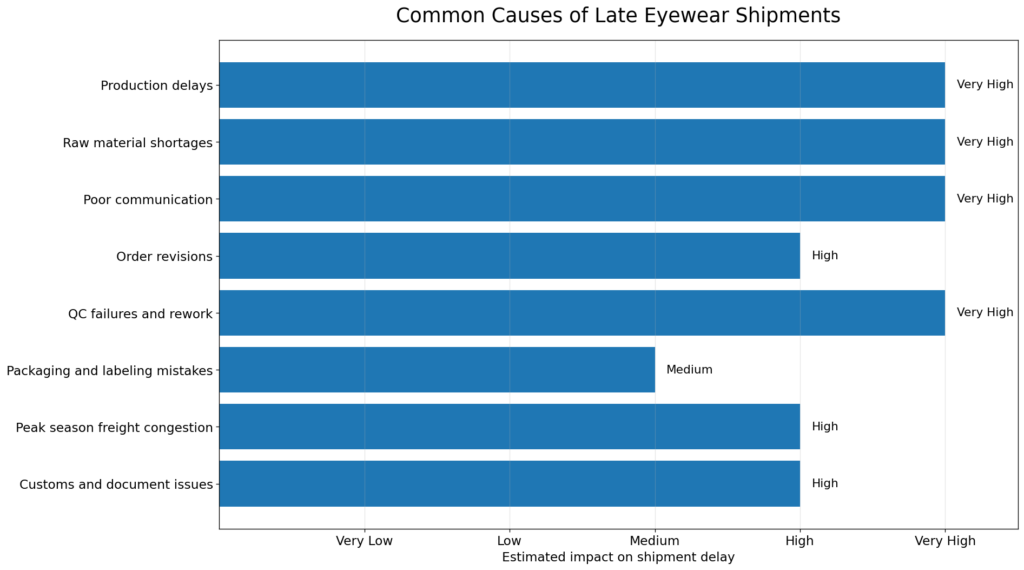
1.1 The most common causes of late eyewear shipments
1.1.1 Production delays in eyewear manufacturing
This is still the biggest one.
When buyers hear “your shipment will be late,” the real issue is often not the shipping company. It is production. The factory may be overloaded, one process may be running behind, or a technical step may be taking longer than planned.
Eyewear production is not a one-step job. A pair of frames has to go through multiple stages before it is truly ready to ship. Depending on the product, that can include cutting, shaping, polishing, hinge installation, logo processing, lens fitting, adjustment, cleaning, inspection, and packing. Even when each stage only slips a little, the total delay adds up quickly.
And that is the part many new buyers underestimate. A factory may be busy long before your order reaches the packing table.
1.1.2 Raw material shortages
Sometimes the delay starts before production even begins.
Factories cannot move on time if the materials are not there. In eyewear, that can mean acetate sheets, metal parts, hinges, screws, nose pads, lenses, logo hardware, cases, cleaning cloths, printed boxes, barcode stickers, or outer cartons. If one of those pieces is missing, incomplete, or late, the whole schedule can shift.
This is especially common on custom projects.
A buyer may feel the order itself is confirmed, but if the custom packaging supplier is delayed or a special acetate color is not available yet, the main factory may still be waiting. From the outside, the order looks active. In reality, it is stuck.
1.1.3 Poor communication between buyer and supplier
A lot of shipping delays are not technical. They are communication problems.
The buyer thinks the supplier understood the logo position. The supplier thinks the packaging artwork was final. The buyer assumes the delivery date means the cargo will be on board. The supplier means the goods will be ready at the factory.
These little misunderstandings sound harmless at first. They are not.
In eyewear projects, details matter. A vague instruction about temple logo size, color reference, lens tint, barcode label, or carton mark can force the factory to stop and wait. And once production pauses, the timeline rarely recovers cleanly.
Poor communication is rarely dramatic. It is usually a series of small unclear moments that quietly eat away at the schedule.
1.1.4 Incorrect order details and repeated revisions
This is one of the most avoidable causes of delay, yet it happens all the time.
A buyer confirms the order, then changes the frame color. Or adjusts the logo artwork. Or updates the pouch design. Or asks to revise the outer carton information after printing has already started. From the buyer’s side, these may feel like minor changes. Inside the factory, they can affect material prep, printing, inspection standards, and packing flow.
The more custom the order is, the more dangerous late revisions become.
Standard wholesale orders usually have less risk because the product and packaging are already established. But on OEM or private label programs, every detail is connected to time. Change one thing late, and several other steps may need to move with it.
1.1.5 Quality control failures and factory rework
Nothing slows down a shipment faster than discovering a problem when the order is supposed to be finished.
If QC finds scratches, alignment issues, loose hinges, poor logo finishing, color inconsistency, lens defects, or packaging errors near the dispatch date, the factory may have to sort, repair, re-inspect, or even remake part of the order. At that point, the delay is not theoretical anymore. It is already happening.
Rework is expensive in time because it disrupts more than one step. Goods may need to be unpacked, reopened, relabeled, reassembled, or rechecked. A batch that looked “basically done” suddenly becomes unfinished again.
That is why buyers who treat QC as a last-minute formality usually end up taking on more risk than they realize.
1.1.6 Packaging and labeling mistakes
Packaging gets ignored too often.
Many eyewear orders are technically finished, but they still cannot ship because the final presentation is wrong. The box may have the wrong barcode. The country-of-origin label may be missing. The carton marks may not match the PO. The warning label may not meet retailer requirements. Or the accessories may have been packed incorrectly.
In private label orders, packaging can be just as critical as the product itself. If the goods arrive with the wrong retail details, the customer may reject the shipment or ask for a correction. That means extra delay, extra cost, and unnecessary friction.
The product may be ready. The shipment still is not.
1.1.7 Peak season congestion and limited shipping space
Even when the factory does its part, the freight side can still create problems.
During peak periods, booking space becomes harder. Carriers change schedules. Ports get congested. Air freight tightens. Cargo can be rolled to the next available departure. Buyers sometimes assume that once the goods are packed, the hard part is over. In reality, there is still another risk layer after factory completion.
This is why experienced importers always separate “factory-ready date” from “actual departure date.”
They are not the same milestone.
And if the order is seasonal, promotion-driven, or tied to a retail launch, that distinction matters a lot.
1.1.8 Customs clearance issues and missing documents
Sometimes the goods are finished, packed, and even collected, but they still do not move smoothly.
That usually means paperwork became the problem.
A missing invoice detail, incorrect HS code, incomplete packing list, inconsistent declaration data, or missing customer-required document can hold up the shipment at export or import stage. And when customs gets involved, even a short delay feels long because the buyer has very little direct control over it.
This is one of those issues that looks administrative on the surface but can have a very real commercial effect.
2.How Production Delays Affect Eyewear Shipments
2.1 Delays in frame manufacturing
Frame manufacturing is often the backbone of the whole order schedule.
If frame production falls behind, nothing after it can move properly. Lens assembly, adjustment, cleaning, packing, and final inspection all depend on the frames being ready first. That is why delays at this stage hit harder than buyers sometimes expect.
For acetate eyewear, the process can involve cutting, CNC machining, tumbling, hand polishing, assembly, and finishing. For metal frames, there may be shaping, soldering, plating, painting, logo processing, and fitting. These steps take time, and they do not always move at the same speed.
One bottleneck is enough to slow the whole line down.
2.2 Lens processing and assembly bottlenecks
Frames are only part of the story.
For sunglasses and many optical-ready styles, the lenses bring their own lead time and production risk. Lenses may need to be cut, tinted, coated, mirrored, laser marked, assembled, or matched to a specific frame structure. If that stage gets overloaded, the order may sit in an awkward halfway state where the frames are ready but the goods are not yet shippable.
This is a common blind spot for buyers.
They may think, “the frames are done, so we are almost there.” But in practice, lens processing and fitting can still take longer than expected, especially when the order includes special lens colors, custom branding, or multiple SKUs.
2.3 Delays caused by custom logo or packaging requirements
Customization always adds time.
That does not mean buyers should avoid custom work. It just means they should respect the extra coordination it requires. A project with engraved logos, printed temples, branded cleaning cloths, custom pouches, folding cases, color boxes, barcode labels, and inserts will naturally move slower than a plain stock order.
The more details involved, the less margin there is for hesitation.
If artwork files are late, if approvals are slow, or if one branded accessory is not ready, the whole delivery schedule can wobble. Buyers who want premium customization need to plan like premium customization takes time, because it does.
3.Why Supplier Communication Problems Lead to Shipping Delays
3.1 Slow response times from sales representatives
A slow reply is rarely just a slow reply.
If the supplier takes too long to answer clear questions about materials, approvals, production status, inspection timing, or freight readiness, that usually reflects deeper coordination problems inside the operation. It often means information is moving slowly internally too.
And once that happens, the buyer loses visibility.
The risk is not only that answers arrive late. It is that decisions get delayed while the order keeps moving forward without enough control. That is when mistakes slip through.
3.2 Unclear production timelines
Some suppliers say things like “around 30 to 40 days” and leave it there.
That is not much help.
A serious supplier should be able to explain what is happening inside that lead time. How long for raw materials? How long for production? When is packaging ready? When is QC expected? When should freight booking begin? Without that stage-by-stage clarity, buyers are forced to plan based on guesswork.
And guesswork is where late deliveries begin.
3.3 Misunderstandings about specifications and delivery dates
This is the kind of issue that does not look serious until the order is already drifting.
The buyer may think a delivery date refers to ETD. The supplier may mean ex-factory completion. The buyer may believe the approved sample includes final packaging. The factory may think only the product itself was approved.
Nobody is necessarily acting in bad faith. But the damage is real anyway.
When specifications and milestones are not written clearly, the order starts running on assumptions. That almost always ends badly.
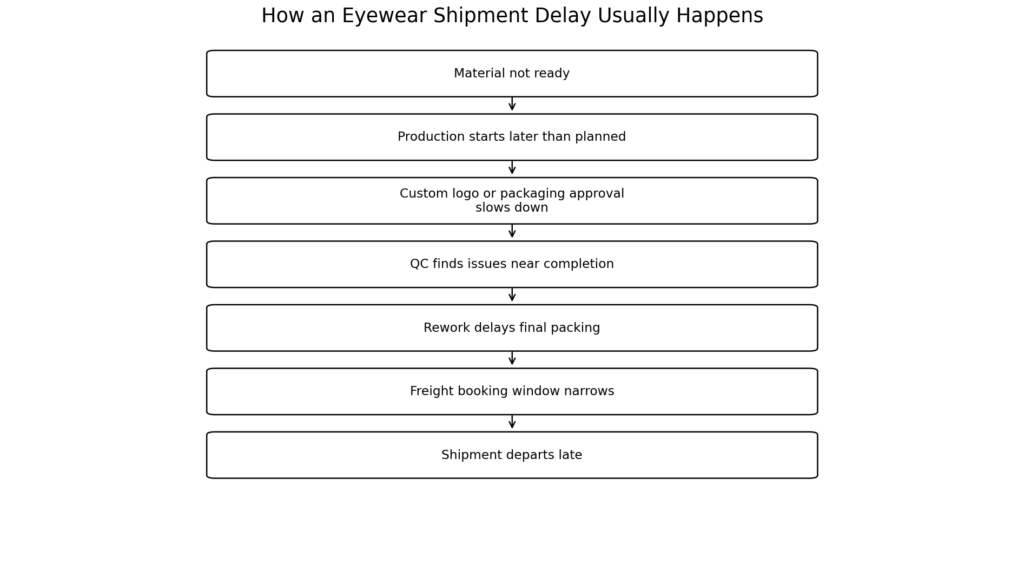
4.How Quality Issues Lead to Late Deliveries
4.1 Product defects found before shipment
Late-stage defect discovery is one of the most painful causes of delay because it happens at exactly the wrong time.
A buyer or inspector may find scratched lenses, uneven polishing, poor logo placement, hinge instability, color mismatch, or packing errors right before dispatch. Once that happens, the factory has to shift from shipping mode back into correction mode.
And correction takes time.
Sometimes the issue is small. Sometimes it affects a large percentage of the batch. Either way, the schedule is under pressure the moment QC problems appear that late.
4.2 Failed inspections and factory rework
A failed inspection rarely means a quick fix.
Goods may need to be resorted, repaired, reopened, repacked, relabeled, or partially remade. Workers need to be reassigned. Supervisors need to check the corrected batch again. In some cases, third-party inspectors need to come back for a second round.
That is why experienced buyers prefer to build QC into the process earlier rather than waiting until the shipment window is already tight.
Finding a problem late is expensive. Finding it early is manageable.
4.3 Delays caused by certification or compliance problems
Some eyewear orders require more than just the goods themselves. They also need the right supporting documents, test records, or market-specific compliance information. If those details are unclear or incomplete, the shipment can be delayed while the buyer and supplier verify what is needed.
This tends to become more important when the order is for a chain retailer, a branded launch, or a market with stricter labeling and documentation expectations.
The product may look fine on the table, but if the paperwork is not aligned with the customer’s requirements, shipping can still be blocked.
5.What Logistics Problems Usually Delay Eyewear Shipments?
5.1 Port congestion and carrier schedule changes
Shipping schedules look solid until they do not.
Ports get backed up. Vessels change routes. Carriers adjust sailings. Flights are rescheduled. And suddenly a shipment that was “supposed to leave this week” is no longer on the plan buyers expected.
This is why real shipping control is not just about asking whether the goods are ready. It is also about knowing whether the booking is confirmed, whether the cargo cut-off is realistic, and whether the route itself is stable.
5.2 Limited container or air freight availability
During busy periods, space is not guaranteed just because a booking was requested.
That matters a lot for eyewear buyers working on seasonal timing, promotional deadlines, or product launches. If sea freight becomes unstable, the fallback may be air freight. But if air space is tight too, the buyer suddenly has fewer recovery options.
Once the order reaches that point, cost usually goes up fast.
5.3 Last-minute booking issues
This one is more preventable than many people think.
A lot of freight problems happen simply because booking started too late. The goods may be ready, but the window for a clean departure has already narrowed. The forwarder has limited options. Cut-off times are missed. The shipment rolls.
From the outside, it feels like bad luck. In reality, it is often late planning.
5.4 High-risk routes and weather disruptions
Not every route performs the same way.
Some lanes are more stable. Some are more exposed to delays, weather risks, customs pressure, or ongoing schedule disruption. Buyers cannot eliminate those external factors entirely, but they can plan with them in mind. When the route is known to be volatile, extra buffer is not optional. It is practical risk control.
6.How Buyers Can Prevent Late Eyewear Shipments
6.1 Choose experienced eyewear manufacturers
This is still the smartest starting point.
A factory with real eyewear experience usually understands where delays tend to happen and how to reduce them. It knows how to plan materials, control key production stages, manage approvals, prepare packaging, and communicate more realistically about lead time.
A cheap supplier can look attractive at quotation stage. But if that supplier struggles with timing control, the hidden cost appears later.
And it usually appears when the buyer has the least room to fix it.
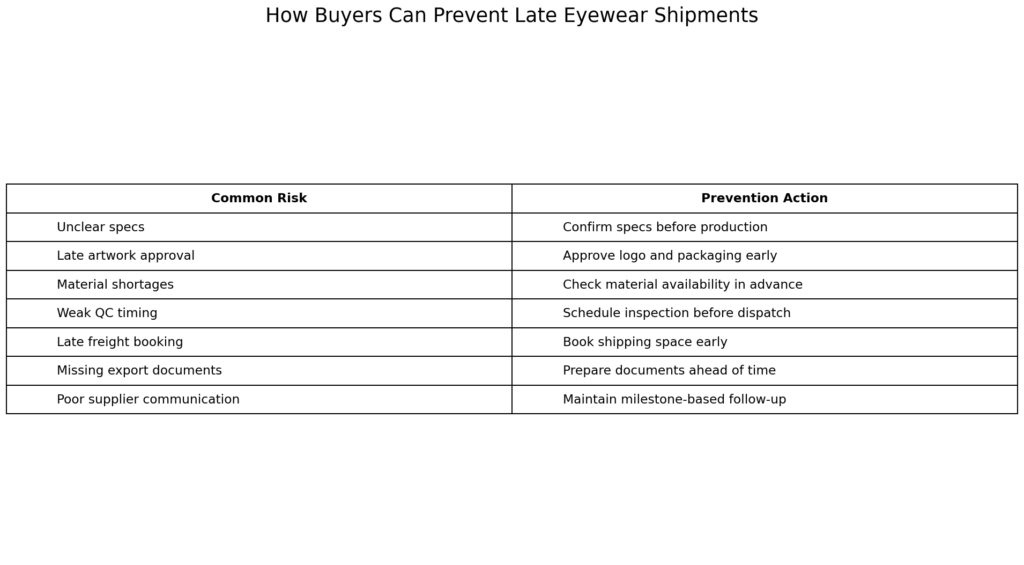
6.2 Confirm specifications before mass production
This sounds basic, but it matters more than almost anything else.
Before mass production begins, buyers should lock down the product specs, color references, logo details, accessories, packaging structure, barcode data, shipping marks, and approval standards. When those details are vague, the factory either slows down to ask questions or keeps moving and risks making the wrong assumption.
Neither outcome is good.
Clear confirmation early saves time later.
6.3 Build a realistic production and shipping schedule
Optimistic timelines are dangerous.
A workable schedule should include production time, packaging time, QC time, booking time, export handling time, and a reasonable buffer for things that do not go perfectly. Buyers who plan only around the ideal scenario usually end up managing stress instead of managing the order.
Good planning is not pessimistic. It is disciplined.
6.4 Check raw material availability early
This step is simple, but it protects the timeline in a big way.
Before promising delivery dates downstream, buyers should ask whether the key materials are already available or still need procurement time. That includes special acetate colors, custom logos, branded cases, boxes, lenses, cloths, inserts, and any non-standard hardware.
If a critical item needs extra sourcing time, it is much better to know that early than to discover it halfway through the order.
6.5 Arrange quality inspection before dispatch
Inspection should happen early enough that it still helps.
If buyers schedule QC too late, any issue found becomes a shipment problem immediately. But when inspection timing is built into the project properly, the factory still has room to correct minor defects without missing the dispatch window.
That is how good QC reduces delay instead of causing last-minute panic.
6.6 Prepare customs and shipping documents in advance
Paperwork should support the shipment, not become the reason it stalls.
Invoice details, packing lists, shipping marks, labeling data, declaration information, and any customer-required documents should be aligned before the goods are ready to leave. If buyers wait until the final days to sort out documentation, they are introducing risk at exactly the wrong moment.
6.7 Keep backup logistics options ready
Not every shipment needs a Plan B, but important ones usually do.
For high-priority orders, buyers should know their alternatives. Could part of the order move by air if needed? Is there another forwarder available? Is there a more stable route if the first option becomes unreliable?
Flexibility does not remove problems. It simply gives buyers more ways to respond when problems appear.
6.8 Maintain frequent communication with the supplier
This is not about chasing the factory every day.
It is about maintaining control through the right checkpoints. Buyers should know when materials are in, when production starts, whether custom packaging is confirmed, when inspection is scheduled, and whether freight booking is actually secured.
The goal is not pressure. It is transparency.
And transparency is one of the best ways to prevent surprises.
7.How to Choose a Reliable Eyewear Supplier to Reduce Delays
7.1 Check factory capacity and production lines
A supplier can look polished online and still be the wrong fit operationally.
Buyers should understand whether the factory can handle the product type, order size, and customization level without overstretching. A supplier that takes on too much work at once may still give attractive lead times up front, but the pressure usually shows later.
7.2 Review export experience and delivery records
Factories with real export experience tend to manage the full process better. They usually understand documentation flow, booking timing, carton control, packing accuracy, and the communication habits international buyers expect.
That kind of experience does not guarantee zero delay. But it often makes the difference between a controlled project and a messy one.
7.3 Verify certifications and compliance documents
If your market, customer, or product category needs specific documentation, ask about it early.
Do not leave compliance questions for the week before shipment. By then, even a simple document gap can become a serious timing problem.
7.4 Evaluate communication efficiency
One of the clearest signs of a reliable supplier is how it communicates before the order is even placed.
Are the replies clear? Are the answers consistent? Do they confirm details carefully? Do they explain timing honestly, or just say yes to everything? Buyers often focus heavily on price and sample appearance, but communication quality is one of the strongest early indicators of delivery reliability.
7.5 Confirm packaging, shipping, and after-sales support
A good supplier should be able to explain not just how it makes the product, but how it finishes the order.
That includes final packing, carton control, shipping coordination, export preparation, and how issues are handled if something goes wrong. Reliable delivery is not only about the production line. It is about the whole order chain.
8.What Buyers Should Know Before Ordering Eyewear in Bulk
8.1 Lead time for wholesale eyewear orders
Lead time is not one universal number.
It depends on the product type, quantity, level of customization, material readiness, season, and complexity of the packaging program. A standard wholesale order will usually move faster than an OEM order with custom logo and retail packaging.
Buyers should also be careful with what “lead time” actually means. Some suppliers refer only to production time. Others mean factory-ready date. That is not the same as delivered-to-port or delivered-to-door timing.
8.2 MOQ and customization requirements
MOQ affects more than price. It affects workflow too.
Low-MOQ custom orders may be possible, but they often come with limitations. Maybe the packaging options are reduced. Maybe the color range is narrower. Maybe the logo method changes. Buyers should understand where the real flexibility is and where it is not.
That makes delivery planning much more realistic.
8.3 Sampling and approval process
Samples are not just for appearance. They are the foundation of bulk order control.
If the sample stage is rushed or handled loosely, problems often show up later in mass production. Buyers should approve samples carefully and make sure the approved version clearly defines the expected standard for product details, branding, accessories, and overall finish.
Ambiguous sample approval almost always creates avoidable trouble later.
8.4 Quality control checkpoints
Strong QC is not one final inspection at the end.
The best bulk eyewear projects usually include several checkpoints: sample approval, material confirmation, in-line production control, finishing checks, packaging review, and pre-shipment inspection. The earlier problems are found, the easier they are to solve.
That is not just a quality principle. It is a delivery principle too.
8.5 Shipping methods and delivery expectations
Sea freight is more cost-efficient for many bulk orders, but it needs more time and more buffer. Air freight is faster, but more expensive and sometimes less predictable during peak periods. Buyers should choose the freight method based on business reality, not just on the rate sheet.
A cheaper method that misses the sales window is not always the cheaper choice.
8.6 Common export documents required
Bulk eyewear shipments usually involve core shipping documents such as a commercial invoice, packing list, transport document, carton details, and customer-specific labeling or declaration information. Depending on the destination market, additional paperwork may also be needed.
The important point is simple: document planning should happen early.
Not after the goods are already packed.
8.7 Risk management tips for importers
The best importers do not assume everything will go perfectly. They build room for normal friction.
That means leaving time buffer, confirming materials early, approving samples properly, tracking milestones, arranging QC in advance, booking freight before the last minute, and keeping written records of every key approval. It also means choosing suppliers for reliability, not only for price.
Because in bulk business, a late shipment often costs more than the savings that came from a lower quote.
Conclusion
Late eyewear shipments rarely happen because of one big dramatic failure.
Most of the time, they come from a chain of smaller issues that were not controlled early enough. A material arrived late. A packaging detail stayed unclear. A logo file changed too late. QC found a problem near dispatch. Freight booking was left too long. A document was missing when the cargo was ready to move.
By the time the buyer hears that the shipment is delayed, the real cause usually started weeks earlier.
That is why preventing late deliveries is not about chasing the factory harder at the end. It is about managing the project better from the beginning. Choose a supplier with real eyewear experience. Lock the specifications early. Confirm material readiness. Build a schedule with buffer. Plan QC before the final rush. Prepare documentation in advance. And stay close enough to the process that problems show up while there is still time to fix them.
In eyewear sourcing, reliability is not just a nice extra.
For many buyers, it is part of the product.