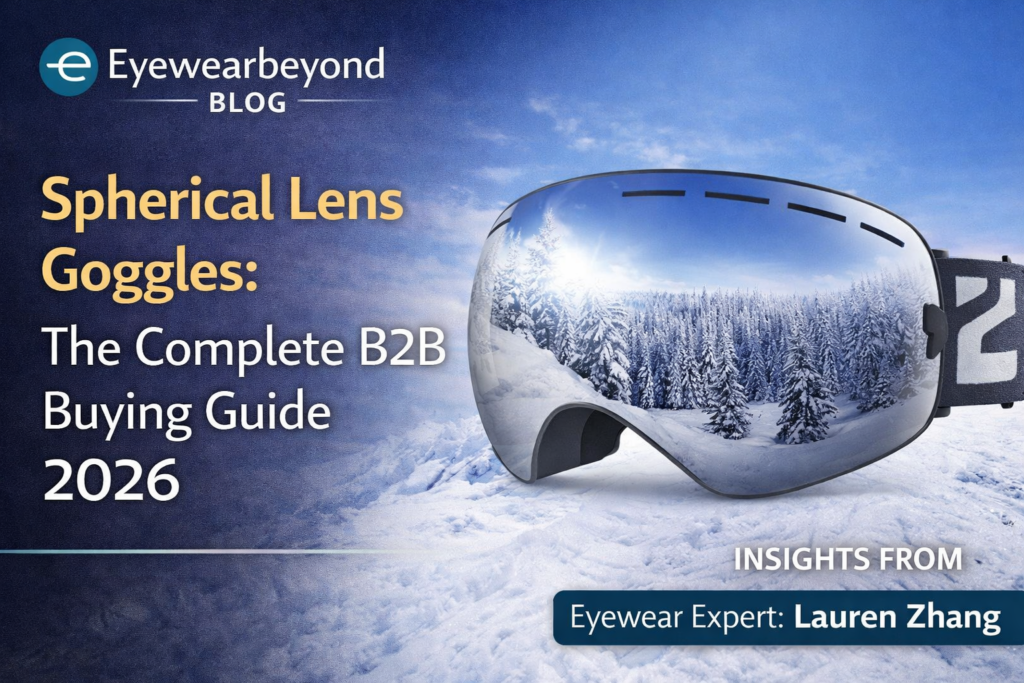
💡 EXPERT INSIGHT
Author / Expert: Lauren Zhang
Role: Eyewear Product & Manufacturing Specialist
Company: Eyewearbeyond – Custom & Wholesale Eyewear Manufacturer“Spherical lenses are popular because they can deliver a wider, more natural field of view—but only when the optics and sealing are done right. For B2B buyers in 2026, focus on three proof points: low distortion across the lens, reliable anti-fog performance in cold/humid swings, and consistent lens-to-frame fit that won’t pop or leak. A supplier that can show test data and repeatable assembly control will protect your returns rate far better than a ‘cool’ mirror finish alone.”
— Lauren Zhang, Eyewear Product & Manufacturing Specialist
👉 Request: Spherical Goggle Buying Checklist (Specs + Tests + QC)
📧 Email: eyewearbeyondofficial@gmail.com
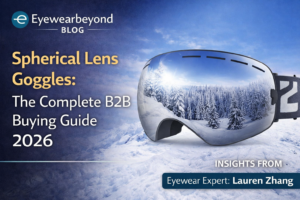
When you walk into a ski shop today — whether it’s in Colorado, Chamonix, or Sapporo — chances are, the goggles catching all the attention have that signature bold, curved bubble-like lens. That’s no coincidence. Spherical lens goggles have become the gold standard in high-performance snow eyewear, favored by pros, influencers, and premium brands alike.
But for B2B buyers, sourcing managers, or brand owners looking to launch or scale their eyewear line, this trend brings more questions than answers.
- Are spherical goggles really worth the higher cost?
- What kind of customer pays for them — and why?
- Can I customize them without blowing up my margins?
- How do they compare to cylindrical or toric lenses from a business perspective?
You’re not just choosing goggles. You’re building SKUs that need to perform, stand out, and generate profit. That’s exactly what this guide is here to help with.
At Eyewearbeyond, we’ve helped dozens of global eyewear brands and winter sports distributors build custom spherical goggle lines — from technical REVO-coated models for alpine racers to stylish frameless designs for Gen Z snowboarders. We’ve seen what works, what fails, and what truly scales.
So if you’re exploring spherical lens goggles as part of your 2026 product strategy, this is your roadmap — packed with the insights you wish suppliers would actually tell you.
Let’s dive in.
What Are Spherical Lens Goggles?
If you’ve ever picked up a pair of high-end ski goggles and noticed the lens looked almost like a wide, outward curve—almost bubble-like—you’ve held a spherical goggle in your hand. But beyond aesthetics, there’s a lot going on behind that shape.
Spherical lenses are engineered to mimic the natural curvature of the human eye, both horizontally and vertically. This design isn’t just for show — it’s built for optical precision. By curving across two axes, spherical lenses help reduce distortion at the edges and provide a more natural field of view, especially in peripheral vision. That means what the wearer sees is closer to reality — no weird warping when they glance to the side, no blind spots, no eye fatigue after hours on the mountain.
For B2B buyers, this matters because you’re not just selling goggles — you’re selling experience. And for serious skiers and snowboarders, that experience hinges on what they can see, how quickly they can react, and how comfortable they feel after a full day on the slopes.
The shape also brings a technical edge. Because of the deeper lens profile, spherical goggles typically offer better airflow and fog resistance. The space between the lens and face allows for enhanced ventilation without compromising warmth or fit. And when paired with quality anti-fog coatings and layered lens construction, the result is a goggle that performs reliably — even in the most demanding alpine conditions.
But let’s be honest: performance is only half the story.
Spherical goggles also look premium. Their rounded lenses give off a sleek, modern silhouette that photographs well, stands out in stores, and — let’s face it — just feels more professional. If you’re positioning your line toward competitive athletes, lifestyle-conscious riders, or anyone willing to pay more for better gear, spherical lens goggles send the right signal. They don’t say “starter pack” — they say, “I know what I’m doing.”
And from a sourcing or product development standpoint, understanding this lens geometry isn’t just about design — it’s about positioning. You’re creating a product that justifies a higher price point, appeals to the top-tier of your market, and offers clear talking points for your sales team or distributors.
Spherical lenses aren’t for every SKU. But when deployed strategically, they elevate your entire product range — and can drive higher margins and customer loyalty in a competitive winter sports category.
Why Spherical Goggles Are More Than Just a High-End Option
It’s easy to assume that spherical goggles are simply a “luxury upgrade” — something you include for athletes or image-conscious customers willing to spend a bit more. But in 2026, that perspective is outdated. For many winter sports users, spherical lenses are not just preferred — they’re expected.
Let’s start with what your customer actually sees.
Because spherical lenses curve both vertically and horizontally, they minimize peripheral distortion in ways flat or cylindrical lenses can’t. That means the snowpark rider can land cleaner, the off-piste skier can spot obstacles sooner, and the casual snowboarder simply feels more confident moving at speed. This kind of performance isn’t just nice to have — it’s the kind of experience that makes users recommend your product.
For brands and distributors, that translates into lower returns, higher reviews, and stronger retention.
But there’s another benefit you might not realize unless you’ve tested dozens of models side by side: fog resistance.
The curved shape naturally allows more space between the lens and the user’s face — which improves airflow and reduces moisture buildup inside the goggle. When paired with dual-layer construction and hydrophilic anti-fog coatings, spherical goggles become a top performer in wet, humid, or rapidly changing alpine weather — exactly the kind of conditions where cheaper goggles often fail.
And when customers pay premium prices, they expect zero fog. Spherical goggles help you deliver that standard — consistently.
Now let’s talk brand perception.
In a retail environment — whether online or in-store — spherical goggles stand out. Their 3D lens shape reflects light differently, photographs better, and gives off a more “technical” vibe that customers associate with high performance. They’re also incredibly Instagrammable, which matters more than ever for snow brands competing in lifestyle and influencer-driven markets.
And in product catalogs or sample decks, they naturally anchor the upper tier. When you offer cylindrical and spherical models side-by-side, the spherical option becomes your hero SKU — the one that gives your entire lineup more credibility and presence.
Finally, there’s the margin advantage.
Because spherical goggles justify a higher retail price — often with only moderate increases in production cost — they offer one of the best value-to-profit ratios in the snow eyewear category. They attract serious buyers, allow you to position your brand as premium, and give distributors or retail partners a compelling upsell option.
In short: spherical lens goggles don’t just perform better.
They look better, sell better, and scale better — when developed with intention.
When Should You Choose Spherical Goggles Over Other Types?
With so many lens options on the market—cylindrical, spherical, toric, even hybrid shapes—it’s easy to get stuck comparing features and specs. But the real question for any B2B buyer or brand developer isn’t which one is best, but rather: which one is right for your customer base and product goals?
Spherical lens goggles aren’t always the cheapest to produce, but they carry unique advantages that make them the smart choice in the right context. Understanding when to use them can help you streamline your product line, improve sell-through rates, and justify a premium position in the market.
Here are some ideal scenarios when spherical goggles should be your go-to:
1. You’re Targeting Performance-Driven Customers
Think competitive skiers, serious snowboarders, alpine tourers. These users demand maximum field of view, minimal distortion, and excellent anti-fog properties. Spherical goggles are engineered for this level of expectation.
2. Your Brand Is Positioned as High-End or Technical
If your brand promises “premium performance” or caters to retailers with upscale customer bases, a well-designed spherical goggle reinforces that image instantly — both visually and functionally.
3. You’re Building a Product Ladder
In a multi-tiered lineup, spherical lens models serve as excellent “anchor” SKUs at the top. They make your mid-range goggles look more affordable by contrast, while still offering high margins themselves.
4. You’re Selling in Markets with Harsh or Variable Climate
For buyers in regions with heavy snowfall, strong UV, or frequent temperature shifts (like Canada, Scandinavia, Japan), the improved fog resistance and optical clarity of spherical goggles add real performance value.
In short, spherical goggles shine when performance and perception both matter.
They’re not the “default option” for every buyer—but when they’re placed intentionally within a product line, they add legitimacy, increase AOV (Average Order Value), and expand your reach into higher-margin channels.
And if you’re working with ski schools, competition teams, or pro influencers — they’re practically non-negotiable.
Key Specs to Consider When Developing Spherical Goggles
Once you’ve decided to include spherical goggles in your collection, the next step is to get the technical details right. But unlike consumer-facing content, where specs are often used as marketing buzzwords, your role as a B2B buyer is to understand how each specification impacts performance, cost, and positioning.
Let’s break down the key specs you’ll need to evaluate when designing or sourcing spherical lens goggles — and more importantly, what they actually mean for your business.
Lens Material Matters More Than You Think
Most spherical goggles use either polycarbonate or nylon lenses. Both are strong and shatter-resistant, but they differ in flexibility, optical clarity, and price.
- Polycarbonate is more affordable and widely used in mid-tier models.
- Nylon (also known as PA) offers better visual clarity, lower distortion, and lighter weight — making it the material of choice for premium spherical goggles.
- For luxury collections, nylon gives your product a noticeable “feel” upgrade and supports ultra-precise lens curvature.
If your brand emphasizes comfort, clarity, or high-speed sports use, nylon is worth the higher cost. For entry-level or fashion-focused SKUs, polycarbonate is typically sufficient.
Coatings Create Perceived Value and Real Protection
Lens coatings are not just functional — they’re part of your product’s story. From the outside, coatings like REVO or mirror give your goggles a distinct visual identity. From the inside, they affect how users perform in different conditions.
Key coatings to consider:
- REVO: Multi-layer optical coating that reduces glare and enhances color contrast. Strong selling point for high-altitude or bright-snow markets.
- Mirror: Reflective coating that reduces light transmission. Visually eye-catching, popular among younger users.
- Anti-fog: Essential on the inner lens surface. High-end coatings last longer and resist smudging better.
- Anti-scratch: Especially important for REVO lenses, which can wear down if not properly protected during shipping or use.
Combining REVO and anti-fog on a spherical dual-layer lens is currently one of the most desirable configurations on the market — and buyers are willing to pay for it.
Lens Thickness and Curvature Impact Comfort and Field of View
Most spherical lenses fall between 1.0mm and 1.8mm thickness. Thicker lenses generally provide better impact resistance but add weight. However, the lens curvature (measured by its base curve, typically 6C to 8C) plays a bigger role in comfort and optics.
- A well-balanced curvature ensures the goggle doesn’t sit too far from the face.
- Poorly designed curvature can lead to frame fit issues, discomfort, or tunnel vision — all of which hurt your return rate.
Working with a supplier that understands these geometric relationships is critical. At the B2B level, you’re not just choosing a lens — you’re choosing the full user experience.
Visible Light Transmission (VLT) Guides Your Regional Strategy
VLT refers to how much light passes through the lens. The lower the VLT, the darker the lens — better for bright sun. Higher VLT is better for cloudy or low-light conditions.
Understanding VLT isn’t just a technicality. It should inform:
- Which lens tints and coatings you offer
- Which markets you prioritize certain SKUs for
- How you train your retailers or reps to educate their end-customers
For example, REVO lenses with a VLT between 15–25% are ideal for sunny regions like Western U.S., Spain, or Chile. In contrast, amber or yellow-tinted lenses with 40–60% VLT work better in Nordic regions or Japan where overcast days dominate.
Dual-Layer vs. Triple-Layer: How Much Is Enough?
Most spherical goggles are built with dual-layer lenses — an outer shield and an inner lens separated by air for insulation. This is the standard anti-fog setup.
Some premium models now offer triple-layer lens structures or integrate proprietary anti-fog membranes. While this does add to cost, it gives you a competitive edge if you’re targeting pro-level performance or marketing through specialized winter sports retailers.
The key is to match lens structure to your customer’s expectations and price point — not to over-engineer a model that won’t yield ROI.
In summary, technical specs aren’t just for engineers. They’re the blueprint of your brand’s promise — and the foundation of product-market fit.
As you evaluate options, make sure every choice — from material to coating to curvature — supports your target user, your pricing model, and your long-term growth strategy.
Frame Design Considerations for Spherical Goggles
The lens might steal the spotlight, but the frame is where most of the comfort — and complaints — happen. For B2B buyers, understanding frame structure isn’t just about ergonomics. It’s about reducing return rates, building loyalty, and making sure your product doesn’t fall apart mid-season.
Spherical goggles, by nature of their larger lens volume and broader curvature, require more thoughtful frame design than their cylindrical counterparts. The challenge? Balancing coverage and comfort — without adding unnecessary bulk.
Frameless, Semi-Frameless, or Full Frame?
Each style serves a purpose — and your market may respond differently depending on regional trends, brand image, or sport type.
- Frameless designs are sleek, lightweight, and popular with younger riders and lifestyle-focused brands. They offer a wider field of view and are ideal for Instagram-friendly product launches.
- Semi-frameless goggles provide structure around the bottom or sides, improving durability while keeping a modern aesthetic. They’re a smart middle-ground for brands that serve both fashion and function.
- Full-frame goggles deliver maximum protection and longevity, often preferred by ski schools, resorts, or alpine athletes who demand rugged performance.
The key is knowing what your end customers value — and building frame architecture that supports that.
Comfort Foam Isn’t Just About Cushion
Most buyers look at the foam layer and think of softness. But it also affects how moisture is absorbed and released — which ties directly into anti-fog performance and wearability.
High-quality goggles typically use triple-layer face foam:
- A firm base layer for structure
- A medium-density layer for fit
- A soft, moisture-wicking layer that touches the skin
This construction not only improves comfort but helps prevent the foam from collapsing after a few uses — a common complaint in lower-end models.
If you’re selling to demanding users — or into rental or high-turnover markets — don’t compromise here. Foam quality directly impacts both perceived value and product lifespan.
Ventilation Design: A Crucial but Overlooked Feature
Spherical lenses already allow for better airflow due to their shape. But if your frame blocks that airflow — or if the vents are poorly placed — you lose the advantage.
Proper venting involves:
- Horizontal channels across the top and bottom of the frame
- Strategic side venting to allow air circulation during movement
- Foam coverings that block snow and dust but still allow breathability
When designed well, your goggles will resist fogging — even when paired with helmets or masks. When done poorly, even the best anti-fog coating won’t help.
If you’re working with factories, always request samples to test ventilation in real-world humidity or cold storage environments. The best specs mean nothing without practical wear testing.
Helmet Integration: Fit Is Everything
For brands selling into performance or safety-conscious markets, helmet compatibility is non-negotiable.
The curve of the frame, the strap angle, and the overall profile must align with common helmet designs. A mismatch here leads to:
- Goggle lift or pressure points
- Cold air gaps
- Complaints from users and lost trust in your product
Some brands even co-design goggles and helmets for a seamless fit. While that may not be feasible for every B2B buyer, understanding this aspect allows you to source models that won’t cause friction on the slopes — or with your customers.
The right frame doesn’t just hold the lens — it holds your reputation.
Whether your focus is comfort, durability, or visual edge, thoughtful frame construction will keep your spherical goggles performing — and your brand positioned as trustworthy, reliable, and worth the price.
Customization Options That Matter in B2B
In today’s competitive eyewear market, offering a well-made spherical goggle isn’t enough. To truly stand out — especially in B2B — your product needs to reflect not just performance, but personality and brand value.
Customization is where that happens. But not all customizations are created equal. Some add value. Others add complexity. Your job as a buyer or brand developer is to know where to invest — and how to maintain efficiency in production.
Here’s where it counts.
Lens Customization: More Than Just Color
The lens is the visual centerpiece of any goggle, and spherical lenses offer a wide surface area for expression. But lens customization goes beyond just “blue mirror” or “silver REVO.”
Practical customization options include:
- REVO coating colors that align with your brand palette or seasonal drops
- Custom VLT ranges tailored for your regional market (e.g., low VLT for sunny resorts in Chile, higher VLT for Nordic light conditions)
- Gradient effects or mirrored layering to create a premium aesthetic
- Laser-etched branding subtly placed at the lens edge
These not only differentiate your product but also create visual consistency across your line.
Strap Branding: Where Identity Comes to Life
The goggle strap is one of the most visible areas for customization — and one of the easiest to overlook. A great strap design can elevate your product from “stock OEM” to “legit snow brand.”
Here’s what’s working in 2026:
- Woven logo straps with raised texture
- Rubber embossed logos for a modern, premium look
- Patterned straps that match apparel trends or national teams
- Fast-release buckle systems for higher-end models
If you’re selling through retail, ski resorts, or influencer partnerships, this is a key area to invest in. It’s also relatively low cost, but high impact — both on-shelf and in photos.
Frame Color and Finish: Subtle but Strategic
While most spherical goggles come in black or white frames, custom color injection or surface treatments can set your product apart — especially in lifestyle and youth markets.
Popular finish options include:
- Matte rubber-touch coatings for a soft, non-slip feel
- Glossy or translucent effects for modern design aesthetics
- Color-fade or dual-tone frames that signal attention to detail
If you’re building a modular line, keep the frame mold consistent but rotate colors each season — it gives you variety without increasing tooling cost.
Packaging: Sell the Experience Before They Wear It
Great packaging makes your product feel premium before the user even puts it on. And for B2B clients selling online or through physical retail, it makes a big difference in perceived value.
Packaging options that work:
- Custom EVA hard cases with zipper and logo
- Recyclable kraft boxes with eco messaging (increasingly important)
- Magnetic closure boxes for high-end retail or influencer PR kits
- Lens care instructions and microfiber pouches included as standard
In bulk orders, you can offer tiered packaging: one version for retail display, another simplified version for rental or promotional use.
Regional Customization Without Blowing Up the Supply Chain
You don’t have to reinvent your whole product for every region. Smart B2B customization means you can:
- Keep the same frame and lens mold
- Offer 2–3 lens tint and coating combinations
- Swap out strap designs by region or season
- Customize outer packaging and insert languages for different markets
This modular approach allows you to serve multiple audiences — from alpine resorts in Europe to lifestyle retailers in the U.S. — without overcomplicating logistics.
When done right, customization doesn’t just make your goggles look better.
It makes your product more memorable, more brandable, and more profitable — all while staying within production logic.
In a B2B landscape where many snow goggles look the same, smart customization is how your line gets noticed, remembered, and re-ordered.
Who Should You Sell Spherical Goggles To?
Even the best-designed spherical goggles won’t sell themselves — unless they’re placed in front of the right audience, with the right message. Unlike mass-market ski goggles that appeal to price-driven buyers, spherical goggles serve a more discerning customer: one who cares about performance, comfort, and visual identity.
But here’s the good news: those customers exist in multiple channels — and they’re often willing to pay more.
Let’s explore where your spherical goggle line has the highest chance of success, and how to position it accordingly.
1. Performance-Driven Retailers and Pro Shops
These are the specialty stores — often near ski resorts — that cater to athletes, advanced recreational users, and serious hobbyists. They don’t want “generic goggles.” They want gear that feels elevated, precise, and reliable.
What they look for:
- High optical clarity, REVO or polarized lens options
- Premium packaging and visual merchandising
- Trusted sourcing (certifications, testing reports)
Your advantage? With the right branding and technical data, your spherical goggles give them something they can confidently upsell.
2. Ski Schools, Resorts, and Rental Operators (Premium Tier)
Not all ski schools run on budget gear. In fact, many higher-end resorts in Europe, Japan, and North America now offer “VIP rental packages” — which include upgraded goggles, helmets, and apparel.
Why it matters:
These businesses aren’t just buying product — they’re delivering a branded experience. Sleek spherical goggles with comfort foam and anti-fog performance help them justify higher rental prices and improve user satisfaction.
Tip: Offer them co-branded straps and custom packaging — small changes with big impact.
3. Lifestyle and Fashion-Oriented Brands
Not every customer is hitting black diamond slopes. Some just want to look good at après-ski, festivals, or winter holidays.
If you’re supplying to streetwear brands, lifestyle retailers, or fashion-forward eyewear labels, spherical goggles offer:
- A bold, futuristic silhouette
- More reflective lens surface for visual appeal
- Space for strong logo or strap branding
You’re not just selling goggles — you’re offering seasonal accessories that complete a look.
4. Influencer or Creator Collaborations
In 2026, DTC brands and social media personalities are launching capsule gear collections — and goggles are often part of the visual identity.
Spherical goggles are perfect for this channel because they:
- Stand out in photos and videos
- Support small-batch customization
- Signal “premium” without feeling inaccessible
If you’re a manufacturer or private label partner, these deals are a win-win: small runs, fast turnover, high visibility.
5. National Teams, Clubs, and Niche Sports Retailers
There’s a steady market in competitive snow sports — from university teams to international training programs. They want function first, but also appreciate a polished, cohesive look.
For these buyers:
- Fog resistance, peripheral clarity, and durability come first
- Strap customization for team colors or sponsors is a big bonus
- Bulk ordering and seasonal replenishment drive long-term partnerships
These accounts may not be huge in volume, but they’re sticky — and often lead to word-of-mouth expansion in regional markets.
At the end of the day, spherical goggles aren’t just about one “type” of buyer.
They’re about premium positioning — and premium buyers exist in many shapes: athletes, influencers, brand founders, rental operators, even fashion designers.
Your job isn’t to chase all of them — it’s to decide which one you’re built for, and build a goggle that speaks directly to what they value most.
Sourcing Strategy for Spherical Goggles in 2026
If you’ve ever tried sourcing spherical goggles from scratch, you already know: this isn’t just about finding a factory and asking for a catalog. Between tooling complexity, coating quality, lens curvature precision, and packaging — sourcing spherical goggles is closer to building a product line than just placing an order.
Especially in 2026, as supply chains shift, consumer expectations rise, and margin pressure tightens, you need more than a supplier. You need a long-term production partner who understands your market.
Here’s how to build a sourcing strategy that works.
1. Don’t Start with Price — Start with Product Fit
It’s tempting to lead with: “What’s your MOQ and best price?”
But spherical goggles vary massively depending on:
- Lens material (Nylon vs. PC)
- Coating types (REVO, Polarized, Mirror, Anti-fog)
- Frame complexity (frameless vs. semi-frameless)
- Strap quality (custom woven vs. printed)
- Accessories included (case, pouch, box design)
Before asking for a quote, define:
- Your target retail price
- Your expected positioning (technical / lifestyle / rental use)
- Key features that must be included
This way, the supplier can recommend suitable configurations — not just their cheapest mold.
2. Evaluate Factories Based on Vertical Capabilities
For spherical goggles, you want a factory that owns or controls key stages of production, including:
- Lens shaping and coating
- Frame injection molding
- Strap weaving or customization
- Assembly and lens alignment
- Quality control (especially anti-fog testing)
Factories that outsource too many steps tend to have inconsistent quality, delayed timelines, and limited flexibility. When possible, look for partners with in-house production lines — like what we offer at Eyewearbeyond.
3. Sampling Is Not Optional — It’s Your Safety Net
Even if the supplier sends you beautiful catalogs, nothing replaces real product testing.
In your sampling process, make sure to:
- Check lens distortion by wearing the goggles outdoors in bright light
- Test anti-fog properties by using them in a humidity-controlled room or ski tunnel
- Inspect strap elasticity, foam density, and helmet compatibility
- Measure actual VLT levels (or request optical testing reports)
This isn’t about being picky — it’s about protecting your brand.
4. Lead Time Planning: Work Backward from Market Dates
For most snow markets, peak sales run from October to February. That means:
- Tooling and sample revisions: March–May
- Final orders confirmed: June–July
- Production & QC: August–September
- Shipping and warehousing: September–October
If you’re working with new suppliers or developing new molds, add 4–6 weeks buffer for first-round adjustments. Too many new brands miss their first season simply because they planned around ideal timelines, not real ones.
5. Watch for Hidden Risks — and Vet Certifications Carefully
Some common sourcing issues with spherical goggles include:
- Inconsistent lens curvature (leading to visual warping)
- Unreliable anti-fog coating that wears off after weeks
- Fake REVO coatings that are purely cosmetic
- Flawed assembly that allows air leaks and fog buildup
- Missing or non-verifiable safety certifications (like EN174, ANSI Z87.1)
Ask for:
- Factory audit reports
- Lens optical testing data
- Anti-fog durability test results
- Full list of materials (for customs and compliance)
Reputable suppliers will offer this upfront — or tell you exactly what level they operate at.
6. Maintain Flexibility in Packaging and Customization
One common issue B2B buyers face: they want a beautiful goggle, but forget to check if the packaging supports global shipping, warehouse stacking, or e-commerce unboxing.
Ideally, choose a supplier who offers:
- Modular packaging options (standard and premium)
- Multi-language insert support
- Efficient shipping carton design
- Pre-assembled vs. flat-packed options for different markets
The goal isn’t to make your goggle perfect — it’s to make it consistently repeatable, with options to scale as demand grows.
Sourcing spherical goggles in 2026 isn’t about chasing the lowest quote. It’s about building a reliable supply base, minimizing downstream risk, and offering products that perform in both sales presentations and real snow conditions.
If you approach sourcing like product development — not just procurement — you’ll position your brand to grow faster, with fewer surprises and stronger supplier relationships.
Pro Tips to Maximize Your Spherical Goggle Sales
Even if you’ve built a technically flawless goggle — with premium lenses, durable frames, and smart customization — it won’t move unless you have a plan to sell it. And in the B2B world, great products still need sales enablement to succeed.
Whether you’re selling direct to retail partners, online through your own brand, or distributing through agents and channels, your spherical goggles need to stand out fast, explain themselves clearly, and justify their price point without a long pitch.
Here’s how to do that — strategically and effectively.
Position the Goggle First — Not Just the Specs
Remember: you’re not selling to engineers. You’re selling to buyers who need a story they can repeat to their customers. That story should focus on:
- Visual advantage: “This shape offers a 180° field of view — with less distortion.”
- Comfort difference: “Triple-layer foam and spherical curvature relieve pressure points.”
- Weather protection: “This lens stays clear even in humid or high-altitude conditions.”
- Brand alignment: “It’s designed for high-performance use — but still looks lifestyle-friendly.”
Frame the product as an experience, not just a technical object. Especially for sales reps, influencers, and visual merchandising teams, this makes all the difference.
Create Tiered Models to Open More Price Points
Not every customer wants the full-featured $120+ goggle — but they may be open to your $80 “lite” version if it still carries the same silhouette and brand DNA.
Smart brands develop good-better-best models within the spherical goggle category. Here’s a typical framework:
- Entry-level: Single REVO lens, basic strap, standard packaging
- Mid-tier: Dual-layer, premium strap branding, EVA case included
- High-end: REVO + anti-fog, magnetic lens, frameless design, premium box
This lets you target multiple markets — from ski schools to e-commerce to luxury retail — without fragmenting your supply chain.
Use Sampling Kits Strategically in B2B Deals
Instead of emailing spec sheets, send a sample box that lets the product speak for itself. Your sales rep or distributor will close deals faster when buyers can touch the foam, test the lens, and compare color options in person.
Your sample kit should include:
- At least 2 lens options (different VLTs or REVO colors)
- One branded strap design
- Packaging sample (folded flat or assembled)
- Product card with specs and pricing tiers
If you’re running a pre-season campaign, include sample kits in your wholesale pitch decks or exhibition booth giveaways.
Tell the “Behind-the-Scenes” Sourcing Story
Buyers love transparency — especially if you’re trying to command a higher wholesale price. Don’t be afraid to show that your goggles are:
- Produced in a certified factory
- Based on high-grade optical material
- Assembled with real QA checkpoints
- Backed by documented testing (VLT, anti-fog, curvature)
This builds trust, especially in markets burned by unreliable factories or “pretty but poor” performance models.
Invest in Strong Visuals and Real-World Content
One of the best ways to sell spherical goggles — particularly online or via catalog — is to let them shine in real snow.
Make sure your marketing toolkit includes:
- Side-by-side photos of your spherical vs. cylindrical goggles
- POV shots showing lens clarity or anti-fog results
- Lifestyle images with helmets, cold environments, and snow gear
- Quick video demos showing magnetic lens swaps or fog resistance tests
This isn’t just for end customers — it helps distributors and retail buyers imagine how they’ll sell it.
Offer Margin Incentives for Volume or Early Commitment
To motivate larger orders or early commitments from retail partners or distributors, consider:
- Early buy discounts for confirmed POs before July
- Tiered wholesale pricing (e.g. lower price per unit after 500 pcs)
- Pre-packaged display bundles (goggles + stand + signage)
- Region exclusivity offers for top-performing accounts
This creates urgency, deepens loyalty, and gives your partners a reason to push your line over others.
Spherical goggles are premium — and should be sold that way.
By controlling how they’re presented, sampled, and priced, you don’t just increase units sold. You build brand perception and long-term positioning.
Treat every goggle as both a product and a brand asset. That’s how you turn great design into great revenue.
Common FAQs About Spherical Goggles
Even experienced buyers and brand founders have questions when it comes to sourcing or customizing spherical lens goggles — especially if it’s their first time working with this product category. The stakes are higher, the specs are more technical, and expectations from end users are rising.
Here are some of the most common questions we hear — along with straightforward, business-savvy answers.
1. Are spherical lenses really worth the higher cost?
Short answer: Yes — if you’re targeting performance or premium positioning.
Spherical lenses offer measurable optical advantages: a wider, more natural field of view, less edge distortion, and better fog management due to their deeper profile. These features improve the user experience, and buyers are often willing to pay more for that.
More importantly, spherical goggles elevate your brand image. They give your catalog a hero product and justify higher MSRP and wholesale price tiers. The ROI is not just in product margins — it’s in how customers perceive your entire line.
2. How do spherical goggles compare to cylindrical goggles in real use?
Cylindrical goggles use a single-axis curve (horizontal only), while spherical lenses are curved both horizontally and vertically — mimicking the shape of the human eye.
In real-world use:
- Spherical goggles reduce peripheral distortion
- They sit slightly farther from the face, which improves ventilation
- They generally fit better with helmets and reduce pressure on the nose and cheekbones
That said, they are usually heavier and costlier, so it depends on your buyer. Many brands offer both types, using spherical as their premium option and cylindrical as their accessible entry-level.
3. Do spherical goggles fog less than other types?
Yes — assuming proper ventilation and coating.
The increased space between the lens and the face allows for better airflow, especially when combined with dual-layer lens construction and anti-fog coatings. This is why high-altitude users and pro athletes often prefer spherical goggles: fog becomes a safety issue at speed.
However, frame ventilation and foam structure matter just as much. Fog performance depends on how well the entire goggle system is designed, not just the lens shape alone.
4. Can spherical lenses be customized with REVO or photochromic coatings?
Absolutely. In fact, REVO coatings look even more stunning on spherical lenses because of the way the lens curves and reflects light. Photochromic (light-adaptive) lenses can also be integrated, but usually increase production cost significantly.
Many brands now offer:
- REVO + Anti-fog dual coating (ideal for bright, humid slopes)
- Photochromic spherical lenses with VLT range 10–50%
- Multi-layer mirror coatings with gradient effects
Ask your supplier whether they can handle these at scale — not all factories have the coating tech or QC to do it well.
5. What’s the typical lifespan of a spherical goggle?
With regular recreational use and proper care, a well-made spherical goggle can last 3–5 years. However, in high-turnover settings (like rentals or team use), wear-and-tear may shorten that to 1–2 seasons.
Factors that affect lifespan:
- Coating quality (cheaper REVO will scratch and degrade faster)
- Strap elasticity and stitching durability
- Foam density and whether it compresses over time
- Lens resistance to impact and cracking in cold environments
Make sure to include proper care instructions in your packaging, and for pro customers, consider offering lens replacements or foam reconditioning kits as part of your after-sales plan.
These aren’t just technical questions — they’re pre-sale concerns. The more clearly and confidently you can address them, the easier it becomes to close deals, earn repeat orders, and stand behind your product line with pride.
Conclusion
As the snow sports market evolves, customers are becoming more informed, more demanding, and more style-conscious than ever before. Spherical goggles offer the rare combination of true performance benefits and high visual impact — making them one of the most effective tools for brands looking to grow, differentiate, and lead.
They’re not for every SKU. But when designed and positioned strategically, spherical lens goggles can become the centerpiece of your product line — driving both margin and credibility.
Whether you’re building a high-performance line for alpine athletes, a fashion-driven snow collection, or looking to refresh your mid-range offerings with premium options, spherical goggles offer you something rare: technical value customers can see — and feel — immediately.
Now is the time to develop products that not only meet expectations, but elevate them.