💡 EXPERT INSIGHT
Author / Expert: Lauren Zhang
Role: Eyewear Product & Manufacturing Specialist
Company: Eyewearbeyond – Custom & Wholesale Eyewear Manufacturer
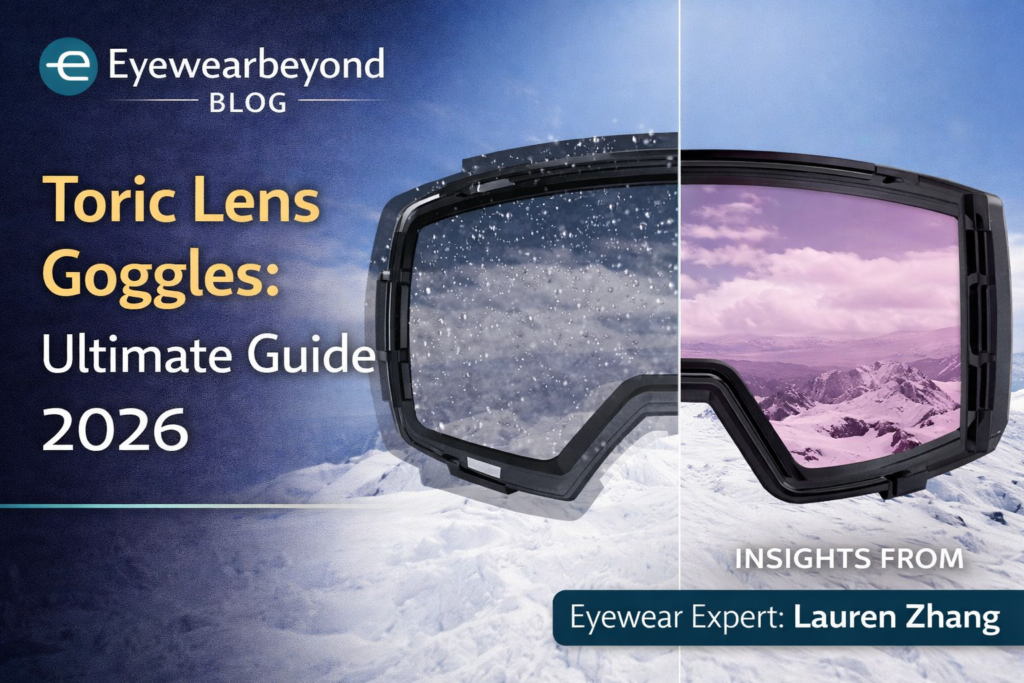
“Toric goggles look premium when the optics and assembly are controlled. In 2026, the real differentiators are distortion management at the edges, consistent lens-to-frame sealing, and durable coatings that survive wipes, cold, and anti-fog treatments. For brands, the safest path is to lock the lens curvature spec early, validate anti-fog and impact performance with test data, and keep reorders stable by controlling mold tolerance and lens fit—not just changing the strap graphics.”
— Lauren Zhang, Eyewear Product & Manufacturing Specialist
👉 Request: Toric Goggle Lens Spec + QC Checklist (Optics, Anti-Fog, Fit)
📧 Email: eyewearbeyondofficial@gmail.com
If you’ve been in the snow eyewear business for a while, you’ve probably noticed something interesting in the past two seasons: spherical goggles aren’t the only “premium” lens shape anymore. A new player is quietly taking over more shelf space and ski slopes — toric lens goggles.
At first glance, they may not seem radically different. But once you put them on — or more importantly, once your customers do — the difference becomes clear. Better fit. Sharper vision. Sleeker profile. And more importantly for you as a brand or distributor: a fresh angle in a crowded product category.
Toric lens goggles are the sweet spot between spherical and cylindrical designs. They’re technically advanced, visually distinctive, and fast becoming the go-to choice for performance-focused users and fashion-conscious snowboarders alike.
If you’re thinking, “Is now the right time to add toric lenses to my lineup?” — you’re asking the right question.
In this guide, we’ll walk you through everything a B2B buyer needs to know:
- What makes toric lenses special
- Why they’re growing in demand
- How to source and customize them properly
- What kind of customers and markets they fit best
- And how to use them to grow your brand’s high-end appeal without overcomplicating your supply chain
At Eyewearbeyond, we’ve worked with snow eyewear brands across the US, Europe, and Japan to develop toric goggle lines that don’t just perform on the slopes — they perform on the market.
Let’s dive in and see why toric might be the most underrated opportunity in ski goggles for 2026.
What Are Toric Lens Goggles?
At first, toric lens goggles might look like a design tweak — just another curved lens. But the difference lies not in how they look, but how they perform. Toric lenses are engineered with dual-axis curvature: one horizontal, one vertical, but each with a different radius. That means they aren’t just round like spherical lenses, nor flat like cylindrical ones — they sit somewhere in between, blending the best of both worlds.
For years, the industry presented the choice as binary: spherical for performance, cylindrical for affordability. Toric lenses break that mold. They offer the wide, distortion-free view of a spherical lens, while maintaining the lower-profile, closer-to-face fit that cylindrical lenses are known for. This makes them particularly attractive to wearers who want clarity and field of vision — without the slightly “bulky” feel that full spherical goggles sometimes create.
But toric lenses aren’t just about comfort. They also help brands differentiate. As ski and snowboard markets mature, and more competitors enter with copy-paste product lines, brands are hungry for something that’s new — but not gimmicky. Toric goggles hit that sweet spot. They look fresh on the shelf, but they also deliver real technical benefits that buyers notice on the mountain.
From a production standpoint, toric lenses require more precision during molding and coating, which is why they’ve only recently become viable for mid-sized brands. But with improved tooling technology and better material control in leading Chinese factories, these lenses are now accessible to B2B buyers looking to upgrade their offering without completely overhauling their cost structure.
In short, toric lens goggles aren’t a trend — they’re a response to the evolving demands of modern snow sport users: people who want performance, style, and a more tailored fit — all in one.
And for the right supplier or brand owner, they’re a compelling reason to rethink what your “next season” lineup should include.
Why Are Toric Lenses Gaining Popularity in Ski Eyewear?
Toric lens goggles didn’t arrive with fanfare. They slipped quietly into the market—first through niche brands, then onto the faces of instructors, athletes, and serious riders. And now? They’re becoming one of the most requested lens types among retailers and resellers gearing up for the 2026 winter season.
So, what changed?
1. They solve a real-world comfort problem
Spherical lenses look impressive, but not every face fits them well. For narrower faces or those with high cheekbones, the oversized bubble-like curve can create gaps or pressure points.
Toric lenses fix that.
Their lower vertical curve hugs the face more naturally while still preserving the panoramic horizontal arc. The result? A secure, ergonomic fit — even for users who’ve always struggled with oversized spherical goggles.
2. They look just different enough
To the average customer, toric goggles don’t scream “technical innovation.” They whisper it. The subtle shape catches the light differently, the profile is more streamlined, and they often sit more flush with helmets or beanies.
For brands, this offers something invaluable:
A new silhouette to sell. One that feels premium, modern, and unique — without alienating users used to cylindrical or spherical options.
3. They offer optical clarity without distortion
Toric lenses minimize the “fish-eye” effect sometimes found in lower-end spherical goggles. Because the vertical curve is flatter, users experience less visual warping, especially at the top and bottom of their field of view.
For skiers and snowboarders moving fast down variable terrain, this translates to more confidence and better reaction time. And for B2B buyers? It means fewer product complaints, higher reviews, and more repeat purchases.
4. They align with the current demand for ‘performance minimalism’
Look at the current aesthetic in snow sports: clean lines, matte finishes, gear that performs but doesn’t shout. Toric goggles sit right in that design sweet spot. They give customers the functionality of pro-grade goggles, in a form that still works for the weekend rider or content creator.
For DTC brands and emerging labels, toric lenses represent design maturity — a way to show customers they’ve thought beyond the obvious.
5. Factories can finally do them right — at scale
Five years ago, toric lens production was expensive, inconsistent, and hard to customize. But now, thanks to advanced CNC cutting, refined injection molding, and upgraded anti-fog coating tech, toric goggles are no longer reserved for top-tier pro models.
Today, a mid-sized eyewear brand can order toric goggles:
- With customized REVO coating
- With interchangeable magnetic lenses
- In low-MOQ production runs
- Without long lead times or huge upfront cost
In other words, they’re finally scalable.
Toric lenses are not hype.
They’re a response to practical needs: comfort, vision, differentiation.
And they arrive at the perfect time — when customers are bored with the usual options, and brands are ready to elevate without reinventing the wheel.
How Does the Toric Lens Structure Work?
To understand why toric goggles perform the way they do, you have to look at what’s going on beneath the surface — quite literally.
Unlike traditional lenses that curve uniformly, toric lenses are built with two distinct curves: one along the horizontal axis (like a spherical lens), and a flatter one along the vertical axis (closer to a cylindrical lens). The result is a lens shape that’s neither entirely round nor entirely flat — it’s a hybrid form designed to follow the natural contours of the human face and eyes.
This isn’t just a visual choice. It’s a functional one.
When you look through a toric lens, your eyes experience a more balanced field of view. There’s less visual distortion at the edges, because the curvature is tailored to how we actually see the world — wider side-to-side than top-to-bottom. Peripheral clarity improves, and the eye has to strain less to “interpret” shapes and movements.
This design also reduces lens-to-face pressure.
Because the vertical curve is gentler, the goggle can sit closer to the cheek and brow without pinching or gapping. That means less discomfort, especially during long sessions or in rental settings where users might not be able to test-fit before use.
From a ventilation perspective, toric lenses also allow for more consistent airflow between the lens and the face. The frame geometry that wraps around a toric lens is slightly shallower, which allows helmet-compatible models to breathe better — a subtle but powerful feature when it comes to fog resistance.
But here’s the key thing from a B2B perspective: toric lenses don’t require a complete redesign of your goggle architecture. If you already work with a supplier that produces spherical or cylindrical goggles, chances are, you can adapt existing molds or strap systems to fit toric options — as long as your manufacturer has the lens tooling precision.
And that’s where a lot of value lies: better fit, better optics, premium perception — all without reinventing your entire product line.
How to Handle Toric Lens Design for Production?
Now that you understand the structure and benefits of toric lenses, let’s get into the part that really matters for B2B buyers and brand owners: how do you actually produce them — consistently, affordably, and at scale?
Toric goggles may look clean and simple when finished, but behind that clean curve is a complex process of material selection, lens shaping, and coating application, each step requiring tighter tolerance than typical cylindrical or even spherical lenses.
So, let’s break down what goes into successful toric lens production — and where you need to be smart as a buyer.
Material Selection: It Starts with the Right Base
You can’t make a high-quality toric lens from low-grade plastic.
The lens shape itself demands optical uniformity, and that means using materials that won’t warp or create stress points under pressure, cold, or humidity.
Most premium toric lenses use either:
- Nylon (PA) – excellent clarity, impact resistance, and lightweight
- Polycarbonate (PC) – more cost-effective, durable, but slightly less optical purity
For high-end models, Nylon remains the gold standard, especially when you want to pair it with REVO, polarized, or photochromic coatings. But for mid-tier models where pricing needs to stay competitive, PC can be a reliable, scalable alternative.
Here’s the key: consistency in raw material sourcing matters.
A good factory will have pre-tested suppliers for optical-grade sheets or pellets and will be able to show material certificates (like Rohs, REACH, FDA grade, etc.).
Molding Precision: Where Many Fail
Toric lenses require multi-axis CNC tooling or highly accurate injection molds. The challenge? You’re not shaping one smooth curve — you’re shaping two, in perfect harmony.
If your mold is off by even a few degrees, it can:
- Distort the field of vision
- Cause fitting issues with your goggle frame
- Lead to inconsistent coating thickness
That’s why factories with in-house mold teams are preferable. They can:
- Adjust draft angles quickly
- Run low-volume test molds before committing to mass production
- Offer smoother transitions from sample to bulk without delays
And let’s not forget: the complexity of toric shapes means more waste in lens cutting. So your cost per unit might be slightly higher — but the visual and performance difference makes it worthwhile.
Coating Compatibility: Not All REVO Is Created Equal
Once the lens is shaped, it needs to be coated — and that’s where another level of complexity comes in. Because toric lenses have asymmetrical curvature, standard coating machines (designed for spherical lenses) may apply REVO or anti-fog unevenly, leading to patchy visuals or durability issues.
What should you look for?
- Vacuum deposition systems that are calibrated for toric curves
- Double-side anti-fog treatments with abrasion resistance
- REVO layering that can bond to both PC and Nylon evenly
- Consistent VLT readings across the entire lens surface
Don’t assume every factory can do this. Ask for real coating samples, scratch tests, and humidity chamber test results. If they can’t provide these, your toric lens may not survive real-world wear.
Assembly Integration: Frame Fit Must Be Perfect
A beautifully molded toric lens means nothing if it doesn’t align with your frame. Because the curvature is asymmetrical, lens-frame integration requires more precise slotting and pressure balancing, especially if your frame uses magnetic lens interchange systems.
Make sure your factory:
- Has done toric + magnetic before
- Uses compression testing on frame-lens assembly
- Offers prototype fitting for strap positioning and nose foam zones
In short: this isn’t just “insert lens and go.” The product must be engineered as a whole, or else your brand risks returns, fogging issues, or user discomfort.
The good news?
Once you’ve locked in the right materials, molds, and coating processes, toric goggles are no harder to scale than other advanced lens types. And with the growing demand from performance riders, influencers, and resort rentals, they offer excellent ROI for brands that get the production right from day one.
How to Choose Toric Goggles for Your Product Line
Toric lens goggles are trending upward — that much is clear. But the real question for brand owners and buyers isn’t just what they are. It’s how to integrate them smartly into your existing product line without cannibalizing your core models or overcomplicating production.
The beauty of toric lenses is their versatility. They’re technical enough for advanced users, stylish enough for lifestyle buyers, and comfortable enough for resorts or rentals. But to make them work for your brand, you need to align lens selection, frame pairing, and end-user targeting.
Let’s break it down.
Start with Your Customer Profile
Are you serving pro athletes? Rental operators? Gen Z riders shopping online? The answer matters.
For example, if your buyers are advanced users or alpine athletes, your toric model should focus on optical performance — things like distortion-free curvature, interchangeable lenses, and anti-fog coatings. But if you’re building for fashion-conscious users, the priority shifts to design, silhouette, and finish — think bold REVO colors, mirrored gradients, and sleek strap branding.
Don’t treat toric goggles as a one-size-fits-all product. Instead, treat them as a canvas — one that you can shape to match the expectations of different sub-audiences in your market.
Match VLT and Lens Coating to Your Target Regions
Light conditions vary drastically between regions. If you’re selling in Northern Europe or Japan, low-VLT lenses that perform in overcast and snowy environments are key. But if your main markets are the Rockies, Alps, or Australian highlands, you’ll want to offer high-contrast, REVO-coated toric lenses with 15–25% VLT for bright sunlight.
Photochromic toric options are growing, but they remain premium and add cost. If you’re targeting high-margin markets or specialized customers (like guides or mountain patrol), they can be a strong upsell.
A smart approach? Build your toric line with 2–3 core lens SKUs that cover 80% of usage scenarios. You don’t need to overwhelm buyers with 10 coatings — just nail the right ones.
Consider the Frame: Don’t Oversize, Don’t Overcomplicate
Toric lenses already give you a visual edge, so there’s no need to go big for the sake of being bold. In fact, one of the appeals of toric goggles is that they offer a more compact, ergonomic profile without sacrificing view range.
Your frame design should follow that principle. Stick with semi-frameless or low-profile full frames, and make sure they integrate cleanly with helmets. Ventilation is especially critical — because toric goggles sit closer to the face, good airflow channels are a must to prevent fog.
Also, don’t forget the strap system. Whether you go printed, woven, or embossed, straps are one of the most visible brand touchpoints — and toric goggles give you the real estate to show it off.
Choose Where to Place Toric in Your Price Ladder
Most brands position toric goggles between cylindrical and spherical models in pricing — not always because they’re cheaper, but because they occupy a middle ground in perception.
That said, toric goggles can absolutely serve as your flagship product — especially if you differentiate through:
- Custom lens tech (anti-fog + REVO + polarized)
- Premium packaging
- Magnetic lens interchange
- Limited edition colorways
Or, you can introduce them as your “stealth upgrade” model — similar in frame to your cylindrical goggle, but with better optics and a new name. This is great for up-selling without the cost of retooling everything.
In short, adding toric goggles to your product line isn’t just about following a trend. It’s about making a strategic move — choosing a lens that meets modern customer expectations, without forcing you to overhaul your entire supply chain.
Do it right, and toric becomes more than a product—it becomes your edge in a competitive market.
Key Points to Note When Sourcing Toric Goggles
If toric goggles are the new must-have in your lineup, then sourcing them right is what will determine whether they boost your brand—or quietly damage it.
Unlike conventional goggles, toric models demand more precision at every stage of the supply chain. The lens shaping, coating, and frame integration all have narrower tolerances. In other words: you can’t just pick any factory from Alibaba and hope for the best.
For B2B buyers, sourcing toric goggles means knowing where the common traps lie—and how to avoid them.
Not Every “Toric” Supplier Is Actually Toric-Capable
It’s easy for a supplier to say “we can make toric.” But can they do it consistently, at scale, and with real optical quality?
Here’s what often goes wrong:
- The lens curvature isn’t true toric—just a slightly curved cylindrical lens marketed as toric
- The factory outsources the lens molding, leading to misalignment with the frame
- Coatings are uneven, especially REVO or mirrored finishes on asymmetrical curves
- Assembly pressure warps the lens, creating visual distortion after shipment
Tip: Always ask for a real toric lens sample, not just rendered photos. Check for distortion, VLT consistency, and surface finish.
Be Clear on Coating Expectations Upfront
Toric lenses challenge even good coating machines, especially for high-demand finishes like:
- Multi-layer REVO with anti-scratch
- Photochromic light-adaptive coatings
- Double-sided anti-fog (inner and outer)
Cheaper vendors may cut corners by applying a single-layer mirror or skipping protective hard coats—leading to fogging, cracking, or easy scratches within weeks of use.
Your RFQ should include not only coating type, but performance expectations:
- VLT range tolerance
- Anti-fog duration (lab-tested hours)
- Abrasion cycles (EN/ISO standards if possible)
This ensures you’re not just buying “toric-looking goggles”—you’re sourcing a functional product.
Test the Frame-Lens Fit Thoroughly
The margin of error for toric lens fitting is smaller than you might expect. If the frame doesn’t follow the dual-axis curve perfectly, you’ll get:
- Light leakage around the edges
- Excessive pressure on the nose or brow
- Compromised fog resistance due to uneven airflow
- Difficulties in magnetic lens swaps (if applicable)
For brands using modular frames or magnetic systems, ask your supplier:
- Whether the toric lens mold was designed for your frame, or just adapted
- How many fitting rounds were done before approving the tool
- If they conduct cold-room testing for assembly performance in real snow conditions
Plan Extra Lead Time for First Production
If this is your first time working with toric goggles—or your supplier’s—build in at least 4 extra weeks for sampling, revisions, and frame alignment.
Unlike cylindrical goggles, toric lenses may require:
- Mold tweaks after the first prototype
- Coating formula adjustments
- Alignment tools for manual assembly
That buffer can mean the difference between hitting a sell-in deadline… or missing an entire season.
Choose Suppliers with Vertical Control
This is one of the biggest sourcing shortcuts: work with factories that do everything in-house, or at least control the lens-making process.
Ask directly:
- Do you mold your own toric lenses, or outsource?
- Is coating done in your facility or via a partner?
- Can you adjust curvature or thickness in future batches?
- Who does final QA, and what are the test procedures?
If the supplier hesitates or gives vague answers—it’s a red flag. You’re about to put your brand’s name on these goggles. You deserve transparency.
Done right, sourcing toric goggles gives you a product that stands apart in design, delivers real comfort, and justifies a premium price.
But done wrong, it gives you expensive returns and frustrated partners.
In this market, quality isn’t a feature — it’s the foundation.
Which Markets Are Best for Toric Lens Goggles?
Toric lens goggles are not for everyone — and that’s exactly why they’re so valuable. They don’t compete in the low-cost, mass-volume lane. Instead, they carve out a growing premium niche where customers want better optics, better fit, and better aesthetics. For B2B buyers, the key is to identify which market segments will not only appreciate toric goggles, but will pay more for them.
Let’s take a closer look at where these products thrive.
Premium Retailers and Specialty Stores
Boutique ski shops, high-end sports retailers, and premium outdoor chains are natural homes for toric goggles. These outlets are not focused on volume. They care about brand image, margin, and performance storytelling. When a goggle looks different, fits better, and offers real technical value — it gives their staff something to talk about, and their customers something to feel good about buying.
For these clients, packaging, presentation, and point-of-sale materials matter. A toric goggle with sleek branding, a hard case, and a clean product card can easily command $100–$160 MSRP.
Direct-to-Consumer (DTC) Brands Targeting Millennials & Gen Z
DTC eyewear brands looking to expand into winter categories love toric goggles for one simple reason: they look amazing in photos.
Compared to spherical goggles, toric goggles offer a lower profile that fits more face shapes (especially for women and younger users), while still providing that modern, curved aesthetic that pops on Instagram, TikTok, and e-commerce galleries. For brands building their identity online, toric goggles are a perfect blend of form and function.
What makes them work in DTC:
- Easier to customize straps and color combos
- Fit is more forgiving without retooling the frame
- Higher perceived value without jumping to full pro-level gear
Upscale Resort Rentals and VIP Ski Schools
Not all rentals are cheap and worn out. At luxury resorts in Japan, Switzerland, and Colorado, there’s rising demand for premium rental packages that include upgraded goggles.
Toric lens goggles are perfect here: they fit a wider range of faces, resist fog better than cylindrical models, and give a “pro gear” feel without being intimidating. Resorts want rental gear that supports their reputation — and toric goggles help justify higher rental fees and longer retention.
They’re also ideal for ski schools targeting adults, couples, or corporate guests who care about comfort and appearance, not just price.
Regional Markets That Value Visual Performance
Some regional markets are naturally more suited to toric lens sales because of their environmental conditions.
For example:
- Japan: frequent overcast and deep powder riding — where anti-fog and wide field-of-view matter
- Canada & Scandinavia: cold, dry air and active alpine communities that invest in gear
- Northern Italy, Austria, Switzerland: stylish riders who appreciate both performance and aesthetics
In these places, toric goggles aren’t just accepted — they’re expected in mid- to high-tier offerings.
Niche Sports Channels and Athleisure Crossovers
Beyond skiing and snowboarding, there’s a growing edge market for goggles used in snowmobiles, winter hiking, mountain rescue, and even tactical sports. In these cases, toric goggles deliver comfort, seal, and visual clarity without bulk — which matters for helmets and mission gear.
There’s also an emerging crossover into fashion and snow-themed streetwear capsules, where goggles are used as accessories. In these collections, the toric silhouette feels more wearable than spherical options.
In short: toric goggles work best where comfort, clarity, and style intersect.
They’re not meant to replace your low-cost lines — they’re built to elevate your offering in markets that want more and are willing to pay for it.
Pick the right channels, and toric goggles won’t just sell — they’ll redefine your brand’s premium tier.
Where to Buy Toric Goggles at Wholesale Price?
So you’ve decided toric goggles make sense for your product line. You understand the performance value, the fit benefits, and the market potential. Now comes the most critical step — finding a supplier that can actually deliver what you need, at scale, and at a competitive price.
But sourcing toric goggles isn’t as simple as typing “toric ski goggles wholesale” into Google or browsing Alibaba. The production requirements are more complex, and many so-called manufacturers are just trading companies or low-tier assemblers. In this part, we’ll show you how to identify real, reliable wholesale sources for toric lens goggles, without compromising on quality or delivery.
Work Directly with Factories Specializing in Sports Optics
Toric goggles are not basic consumer goods — they’re a mix of optical engineering and precision plastic injection. This means your ideal supplier should not only produce frames and lenses, but also understand:
- Optical curvature design
- Multi-layer lens coatings (REVO, anti-fog, mirror, etc.)
- Toric-specific frame integration
Factories that specialize in snow goggles and sports sunglasses are far more capable of producing toric models consistently than general PPE or fashion eyewear vendors. Look for partners with in-house tooling, lens cutting, and coating capabilities, as these reduce risks of misalignment, delays, and inconsistent batches.
If you’re unsure, request:
- Videos of their production line
- Sample reports (QC, VLT testing, fog tests)
- OEM project case studies (ideally in snow goggles)
Choose Suppliers with Flexible MOQs and Custom Options
As toric goggles are still a “premium” SKU for most brands, you may not want to commit to 10,000 units right away. A good supplier will offer low to mid MOQ starting from 300–500 pcs per color, with flexible upgrades in:
- Lens types (toric clear, REVO, photochromic)
- Strap customization (woven, sublimation, rubber logo)
- Packaging (EVA case, branded box, POS displays)
This flexibility lets you test the market or launch limited editions — without inflating your inventory risk.
China Still Offers the Best Value — If You Know Where to Look
There’s no question: China remains the most competitive hub for ski goggles manufacturing, including toric lens models. But not all suppliers are equal.
The best toric goggle factories are usually located in:
- Zhejiang (Wenzhou / Taizhou) — strong in sports eyewear, lens coating, export logistics
- Guangdong (Shenzhen / Dongguan) — more DTC-friendly, with design capabilities
- Jiangsu (Danyang area) — historically focused on optical precision
Be cautious of overly “cheap” quotes. A real toric goggle with REVO coating, anti-fog lens, and branded strap should cost more than a basic cylindrical model. If someone offers $3–4 FOB for a “toric goggle,” you’re likely looking at a repackaged cylindrical item.
Target wholesale FOB prices (for 2025/2026 production):
- Basic toric lens with standard anti-fog: $6–$8 USD
- Mid-range toric with REVO + strap branding: $8–$11 USD
- High-end toric with magnetic lens + hard case: $12–$16 USD
Don’t Rely Solely on Trade Shows or Directories
Canton Fair, ISPO, or online sourcing sites can help you discover potential partners — but they should never replace due diligence. Always:
- Ask to see real toric production references
- Order a fully branded prototype set (not just random samples)
- Test packaging, strap quality, and assembly in cold-room conditions
If a supplier can’t deliver a complete pre-production sample that matches your specs within 2–3 weeks, it’s a red flag. In today’s fast-paced cycle, responsiveness is as important as capacity.
Consider Working with Eyewearbeyond
(Only if needed — otherwise skip promotional line. ✅)
Eyewearbeyond is one of the few China-based manufacturers offering true toric goggle customization at mid-level MOQs, serving brands across North America, Europe, and Asia. With our in-house lens lab, coating line, and five streamlined production lines, we’re set up to deliver premium-level snow goggles without premium delays.
In summary: sourcing toric goggles at wholesale price is absolutely possible — but only if you’re working with the right kind of supplier.
Prioritize technical capability, ask the right questions, and test before you scale. Your customers will feel the difference — and your brand will reap the rewards.
FAQ About Toric Goggles
Even after understanding the design, market fit, and sourcing strategy for toric goggles, B2B buyers still have questions — and rightly so. Introducing a new lens type into your product line isn’t just about specs; it’s about knowing how it will perform, sell, and scale.
Here are five of the most common questions we hear from brand owners, wholesale buyers, and product managers exploring toric lens goggles for the first time — along with straight, no-fluff answers.
1. Are toric lenses better than spherical lenses?
They’re not necessarily better — they’re different, and often more versatile.
Toric lenses combine the clarity and wide view of spherical lenses with a more face-conforming, low-profile fit. This makes them ideal for brands targeting comfort, style, and broad usability across diverse face shapes.
For high-altitude or pro use, spherical still dominates.
But for most consumers and mid-premium brands? Toric offers 90% of the optical benefit at a lower profile and sometimes a lower cost.
2. Do toric lenses cost more to manufacture?
Slightly — but not dramatically.
Toric lens production involves more complex curvature molds and coating machinery, so you might see a cost increase of 10–15% over cylindrical lenses. But the right factory can manage this efficiently, especially if you scale.
What you get in return: a product with higher perceived value, less competition, and stronger visual branding. That cost difference can translate to better margins at retail.
3. Are toric goggles more resistant to fog?
Generally yes — especially when combined with quality coatings and ventilation design.
Because toric lenses sit closer to the face than spherical ones, they create a more efficient thermal barrier (especially in dual-lens constructions). The curvature also allows for smarter airflow paths through the frame, which reduces internal condensation.
Just make sure the anti-fog coating and foam quality match the lens type — lens shape alone isn’t enough.
4. What’s the difference in fit vs. other lens types?
Toric goggles fit more naturally across a wider range of users. The flatter vertical arc reduces pressure on the forehead and nose, while still allowing a curved horizontal field of view.
For brands targeting female users, younger riders, or anyone who finds spherical goggles too bulky, toric lenses are often the best fit option.
They’re also more compatible with helmet integration, which matters in both retail and rental settings.
5. Can toric lenses support REVO, photochromic, or polarized coatings?
Yes — but it depends on your supplier’s equipment.
Toric curvature requires adjusted coating angles to maintain even VLT across the surface. High-end REVO coatings and photochromic films can absolutely be applied to toric lenses, and many premium snow brands already do so.
Ask your factory:
- What coating machines they use (vacuum, spray, dip)?
- What’s the average VLT deviation across the lens?
- Can they do dual coating (e.g. REVO + anti-fog)?
If the answers are vague, it’s time to look for a more experienced partner.
Toric goggles may be new territory for some — but they’re not complicated when you know what to ask.
By understanding how they differ from other lens types and where their value lies, you’ll be in a strong position to add a standout product to your next snow season lineup.
Conclusion
In a snow goggle market saturated with copycat designs and recycled SKUs, toric lens goggles offer something refreshingly different — not just in looks, but in real-world performance.
They combine the best of both worlds: the wide-angle clarity of spherical goggles and the ergonomic fit of cylindrical ones. They reduce distortion, enhance comfort, and elevate your product offering without introducing unnecessary complexity into your supply chain.
For B2B buyers, this is more than a design update. It’s a business opportunity. Toric goggles let you:
- Differentiate in a competitive catalog
- Target premium segments without inflating cost
- Offer a product customers will feel is better — not just see
As the 2026 season approaches, the brands that win will be the ones who know how to evolve with their customers. Toric goggles are no longer just a “cool alternative” — they’re becoming the new standard in premium snow eyewear.
If you’re building a brand that’s designed to grow, toric goggles deserve a place in your line.